The Thalapathy Variable: What Vijay had that Kamal and Pawan Kalyan simply didn't?

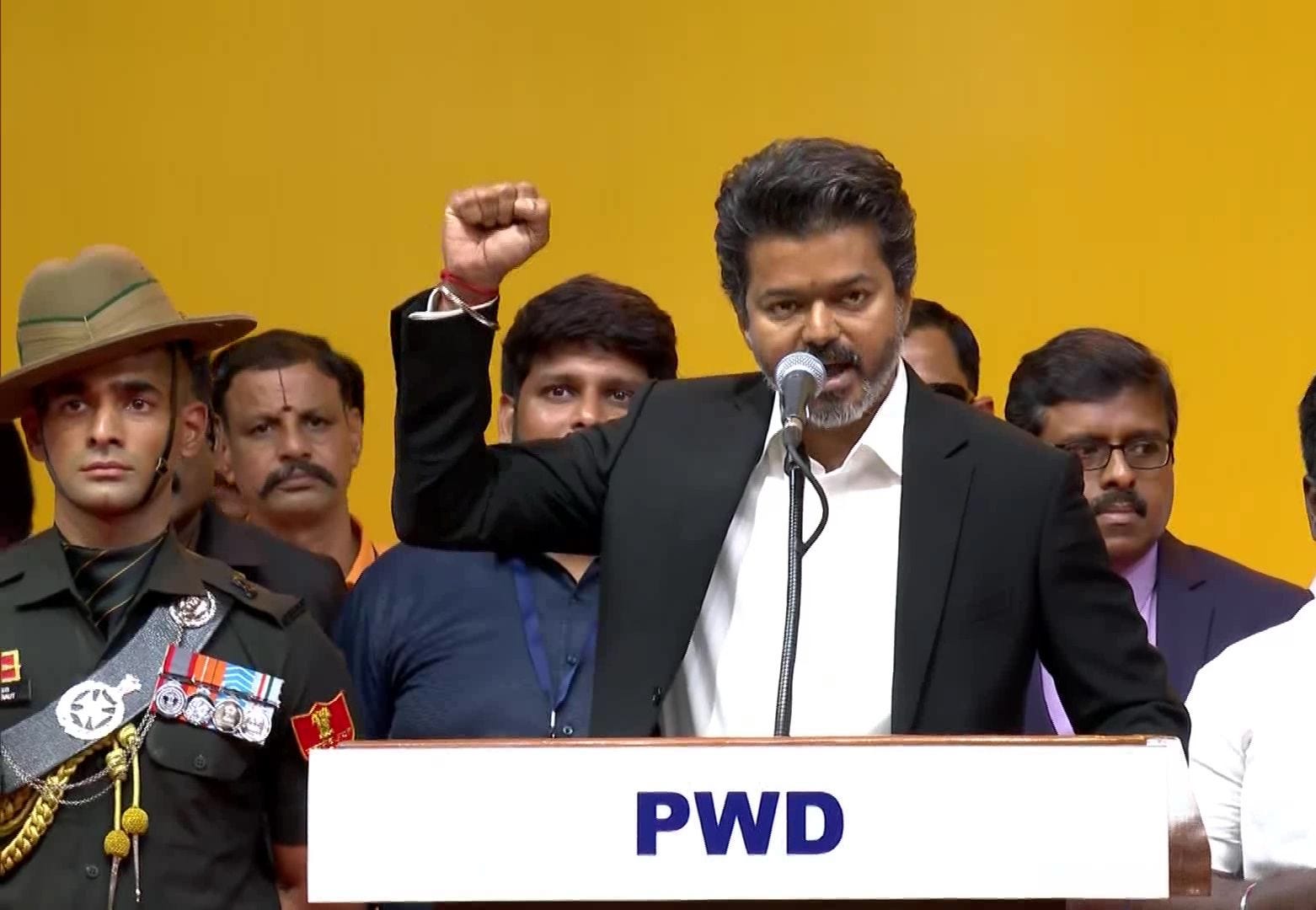
Today, May 10th, Tamil Nadu scripted a new chapter in its political history.
In a historic moment that ended six decades of Dravidian parties dominance, actor-turned-politician Chandrasekhar Vijay Joseph, founder of the Tamilaga Vetri Kazhagam (TVK), took oath as the Chief Minister of Tamil Nadu. By leading his nascent party to a stunning electoral breakthrough, Vijay has become the first leader in over 60 years to shatter the entrenched duopoly of the DMK and AIADMK.
How did a superstar from the silver screen achieve what seasoned politicians and fellow actors like Kamal Haasan and Pawan Kalyan could not? Let’s examine the Thalapathy Variable in detail.
On one hand, film stars have long tried to translate screen charisma into electoral power. From MGR to Chiranjeevi, the subcontinent is littered with actors who believed the crowd at the multiplex would follow them to the ballot box. Some succeeded spectacularly. Most did not.
On the other hand, Tamil Nadu, in particular, has a deeply entrenched two-party system. The DMK and the AIADMK have alternated power with clockwork regularity since 1967. Not a single third force has ever broken that duopoly in its debut outing, until now.
This creates a fascinating question, doesn’t it?
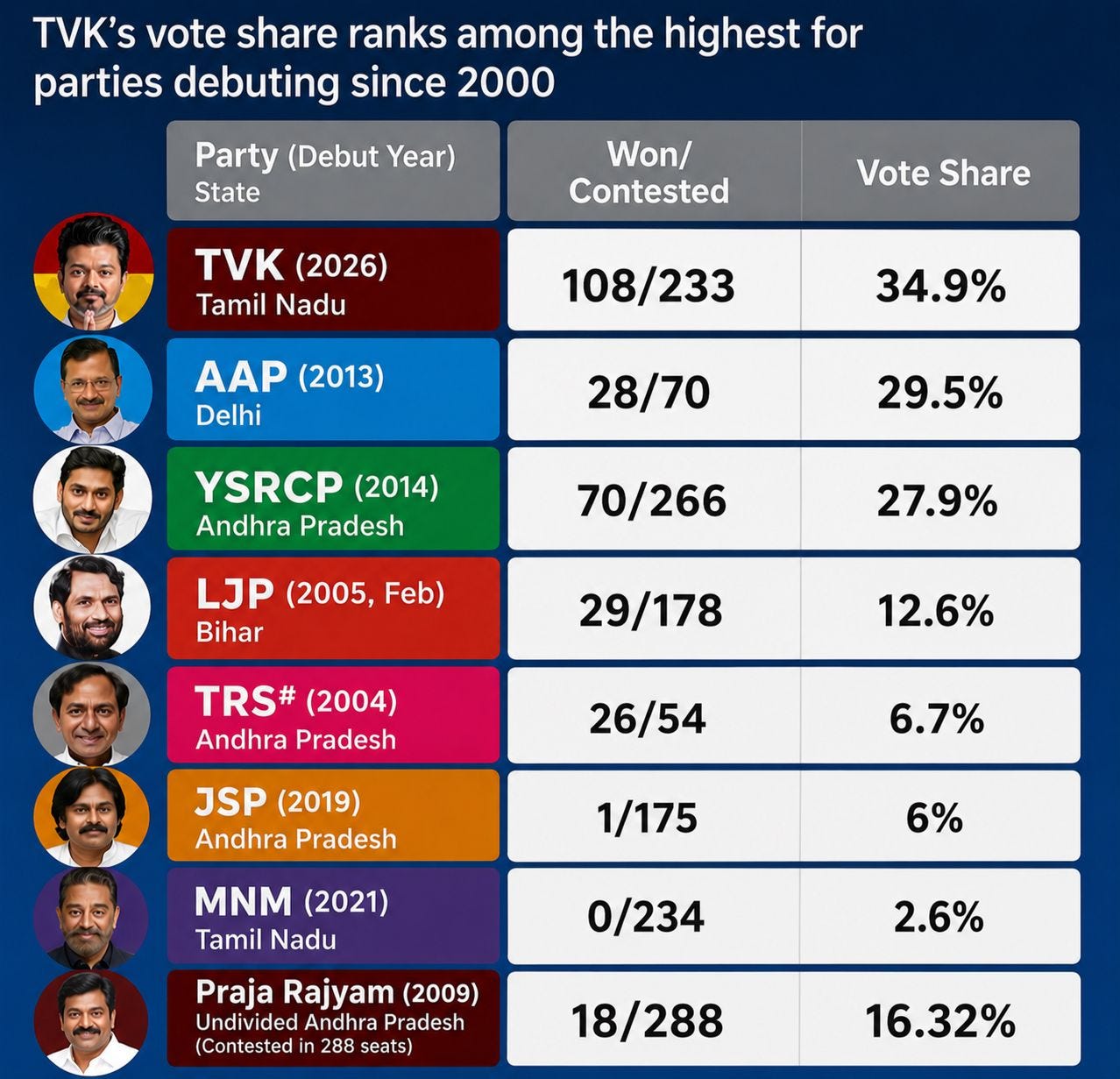
What did Joseph Vijay Chandrasekhar, “Thalapathy” to his fans, have that Kamal Haasan and Pawan Kalyan simply did not? Why did TVK win 108 seats in its very first election while MNM drew a blank in 2021 and Jana Sena limped to a single seat in 2019? And where does this rank in the history of debutant parties in the 21st century?
TVK’s debut stands out as one of the strongest performances by any new party in India this century. Among major debutant parties since 2000, TVK’s 34.9% vote share in 2026 ranks at the very top, ahead of AAP’s 29.5% in Delhi (2013), YSRCP’s 27.9% in Andhra Pradesh (2014), LJP’s 12.6% in Bihar (2005), and TRS’s 6.7% in Andhra Pradesh (2004). Notably, TVK achieved this as a completely unallied single party, securing 107 of 233 contested seats and emerging as the single largest party in a hung assembly, a feat unmatched by these contemporaries in terms of immediate vote share impact.
To understand that, it helps to look at what actually separates a political superstar from a star who plays at politics.
The Cinema Was Always the Campaign
In a traditional setup, an actor decides at some point that they want to enter politics, launches a party, and then tries to convince voters to transfer their cinematic loyalty into political trust. The problem is that this transfer rarely happens automatically.
Kamal Haasan attempted exactly this. He launched the Makkal Needhi Maiam (MNM) in 2018 with genuine intellectual ambition. His pitch was cerebral, good governance, rationalism, and anti-corruption. It was the pitch of a man who had spent a lifetime making films that challenged Tamil society’s assumptions. And yet, when the 2021 assembly election came, MNM won zero seats. Kamal himself lost his own constituency.
Pawan Kalyan’s Jana Sena in Andhra Pradesh faced a similar fate in 2019. One seat. Out of 175. Despite Pawan being a genuine mass entertainer with a massive fan following.
What went wrong?
The answer lies in how they used, or failed to use, the decade before the election.
Vijay did something structurally different. From 2013 onwards, nearly every major Vijay film carried an unmistakable political current. Thalaivaa (2013) was tagged “Time to Lead.” Kaththi (2014) was about farmers and corporate exploitation. Sarkar (2018) explicitly depicted his character fighting ballot fraud. Master (2021) was about institutional corruption. By the time Vijay formally announced TVK in February 2024, Tamil voters had spent over a decade watching him play the role he was now asking them to give him in real life.
His films were not just entertainment. They were, in retrospect, a decade-long manifesto delivered one blockbuster at a time.
The Kamal Problem: Too Intellectual, Too Late
This is where the gap becomes vivid.
Kamal Haasan is arguably the more talented actor. His filmography, Nayakan, Sadma, Anbe Sivam, Vishwaroopam, is a study in range and artistic courage that Vijay’s commercial entertainers cannot match on an aesthetic level. But artistic courage is not the same as political resonance.
Kamal’s films, particularly the ones associated with his political persona, spoke to a niche: the educated, rationalist, Dravidian-reformist voter. MNM’s messaging often felt like a lecture rather than a conversation. Voters in Tamil Nadu’s semi-urban and rural belts, where elections are actually won, did not see themselves reflected in it.
Vijay, by contrast, has always been unapologetically mass. His films cast him as the common man’s champion, someone who fights for the farmer, the student, the labourer. That archetype does not need translation for a first-generation voter in Tirunelveli or Dharmapuri. There is also a question of timing. Kamal entered politics in 2018, after his public image had somewhat cooled. Vijay entered in 2024, when his fandom was arguably at its most organised and politicised. Fan clubs, which had been running welfare activities for years, converted with remarkable efficiency into a political ground force.
The Pawan Paradox: Wrong State, Wrong Moment
Pawan Kalyan’s story is a different kind of cautionary tale.
Jana Sena’s 2019 debut was catastrophic, one seat in 175, despite Pawan being Andhra Pradesh’s most beloved star of his generation. But the structural conditions were deeply unfavourable. YSRCP had the momentum of a sympathy wave following YS Rajasekhara Reddy’s death. Jagan Mohan Reddy had spent years building a ground organisation through his padayatra. Jana Sena, launched in 2014 but active electorally only in 2019, entered without a comparable organisation and without a clearly differentiated ideological position.
There is also a caste dimension that cannot be ignored. Jagan had consolidated Reddy and backward caste votes with rare efficiency. Pawan’s Kapu community support, while real, was numerically insufficient to carry the kind of seats that would make a dent.
Vijay, interestingly, navigated the caste question differently, not by leaning into it, but by building a welfare-centric manifesto that cut across caste lines. Free gas cylinders, monthly financial assistance for women, free bus travel, these are not caste programmes. They are class programmes. And in Tamil Nadu’s particular political culture, where welfare delivery has been the primary language of electoral competition since MGR, Vijay was fluent.
The MGR Feat, Explained
Why does it matter that TVK is being compared to MGR’s 1977 triumph?
MGR launched the AIADMK in 1972 after breaking from the DMK. Five years later, in 1977, his party won the election outright, an actor-turned-politician forming government on his own, in his first real electoral test as party leader. No one had done it before in Tamil Nadu. No one had managed it since.
Until now.
TVK won 107 of 233 contested seats, a 34.9% vote share, as a single, unallied party with no coalition, no seat-sharing, and no ideological compromise. It emerged as the single largest party in a hung assembly, with both the DMK and AIADMK reduced to secondary status. Incumbent Chief Minister MK Stalin lost his own seat at Kolathur, only the second sitting CM in Tamil Nadu’s history to lose a constituency election. The parallel with MGR is not just symbolic. It is structural. Both men converted cinematic mass appeal into political capital within two years of founding their party. Both ran as outsiders against the existing Dravidian order. Both won by speaking directly to the economic anxieties of the state’s working class. And both did it without borrowing legitimacy from established parties.
So What Did Vijay Have?
Three things, fundamentally, that neither Kamal nor Pawan possessed in sufficient measure.
The first is ideological legibility. Vijay’s political persona, embedded across a decade of films, was immediately readable to the average Tamil voter. He was not a new face asking for a leap of faith. He was a familiar face asking for a formal mandate.
The second is organisational infrastructure. The TVK fan club network, which had been running blood donation camps, flood relief, and community welfare for years, converted into a campaign machine with remarkable speed. Kamal’s MNM had neither the fan base depth nor the organisational maturity.
The third is the welfare language. Tamil Nadu’s voters have been trained, since MGR’s free noon meal scheme in the 1970s, to evaluate political offers in terms of direct material benefit. Vijay’s manifesto, focused on women-centric welfare, employment, and cost-of-living relief, was written in that language. Pawan’s manifesto was written in the language of special status and regional pride. Kamal’s was written in the language of governance reform. Both are valid. Neither was what Tamil Nadu and Andhra was listening for in that moment.
Whether Vijay can now translate electoral success into effective governance remains the most crucial question. Forming a stable government in a hung assembly demanded sharp coalition arithmetic, legislative management, and bureaucratic finesse, skills no film role could have prepared him for. It took almost a week of intense negotiations for Vijay to convince the Indian Union Muslim League (IUML), the Viduthalai Chiruthaigal Katchi (VCK), and the Communist parties to extend support. This intricate numbers game proved to be a swift and sobering lesson for Joseph Vijay in the hard realities of politics, far removed from the straightforward heroism of his on-screen roles.
True to his promise of generational change, Vijay has appointed eight first-time MLAs as ministers, all young, well-educated professionals chosen on merit rather than seniority or caste considerations. Among them is Selvi S. Keerthana, the youngest member of his cabinet at just 29 years old. Other members in cabinet are also very young, with many in their late 30s and 40s. Their elevation has been widely celebrated as a powerful symbol of the fresh energy and new leadership Vijay is attempting to bring into Tamil Nadu’s governance.
But for now, the sensation is real. The MGR feat has been replicated. And the question of what comes next, for Vijay, for Tamil Nadu, and for the long line of film stars who will inevitably watch and wonder, is the one worth watching.
(Written by Tottempudi Gagan)
A fascinating breakdown of the 'Thalapathy Variable.' You’ve hit on the crucial differentiator: that Vijay spent a decade social-engineering his platform through cinema. This has been a resounding success. TVK secured 38% of votes on a record 85.1% turnout.
However, the real test begins now. Tamil Nadu is currently India’s 'Make in India' success story with per capita income nearly double the national average. The question now is whether Vijay’s cabinet of first-time MLAs can maintain the industrial policy continuity that has made the state a hub for global giants like Hyundai and Vinfast.